What if managing agents felt like playing Starcraft?
Too many tabs.
Too many terminals.
Zero clarity.
AI CLIs are powerful. But to use them productively, you need to run them in parallel — across multiple tasks, sometimes across multiple projects.
Some think terminals are enough — just split the screen 6 times, open some tabs. But what about 20 agents? Or 50? Or 100?
At that scale, tabs and splits completely break down.
The core question:
How do you give a human intuitive control over many things at once?
A spatial interface
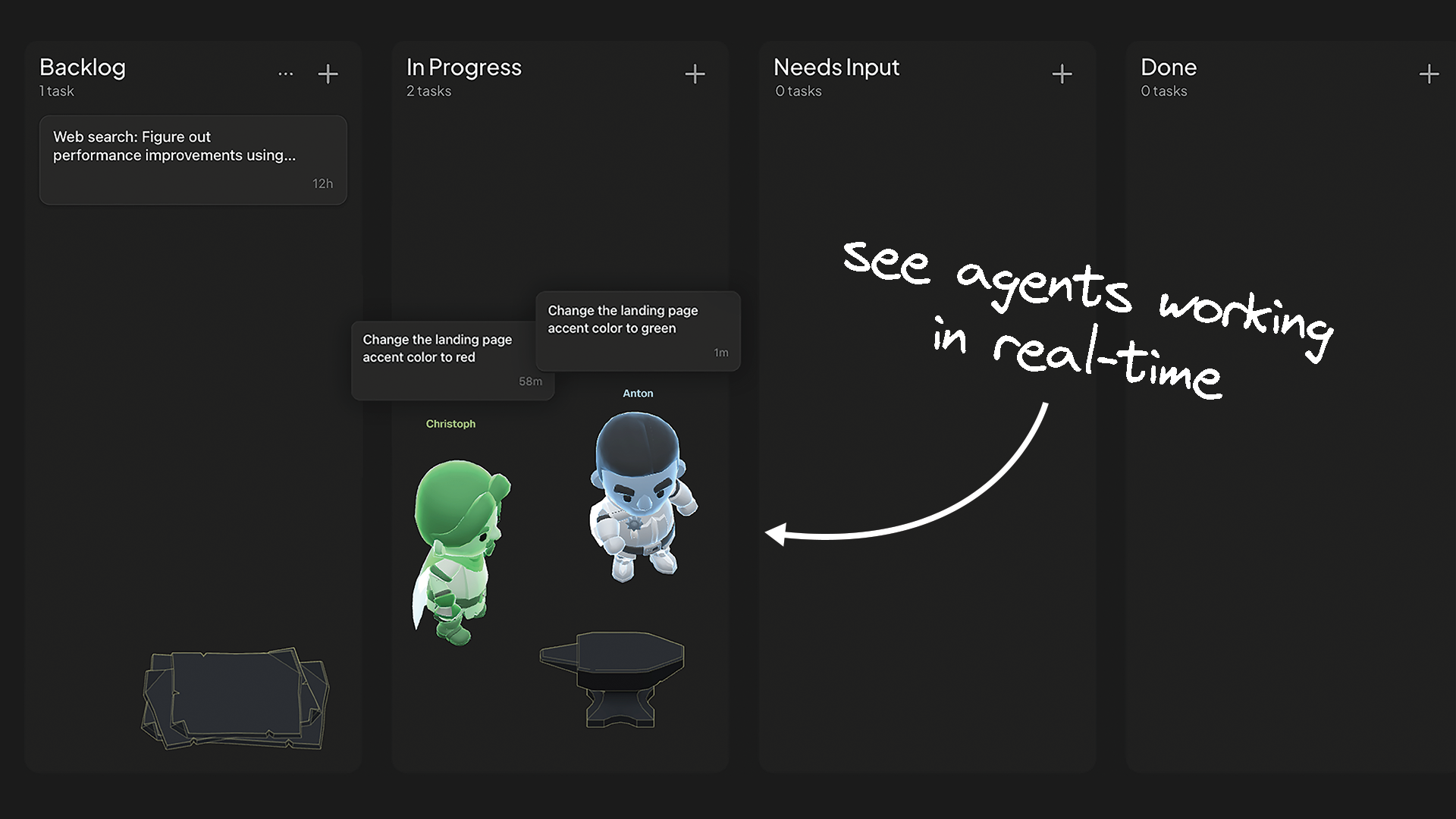
A 3D environment where your agents exist as characters you can see, select, and direct.
Your brain is built for this. It's why video games work — you don't just look at the screen, you feel like you're in the environment.
Spatial Understanding
See all your agents at a glance. Know instantly what each one is doing.
Intuitive Control
Point. Click. Deploy. No command line gymnastics required.
Strategic Overview
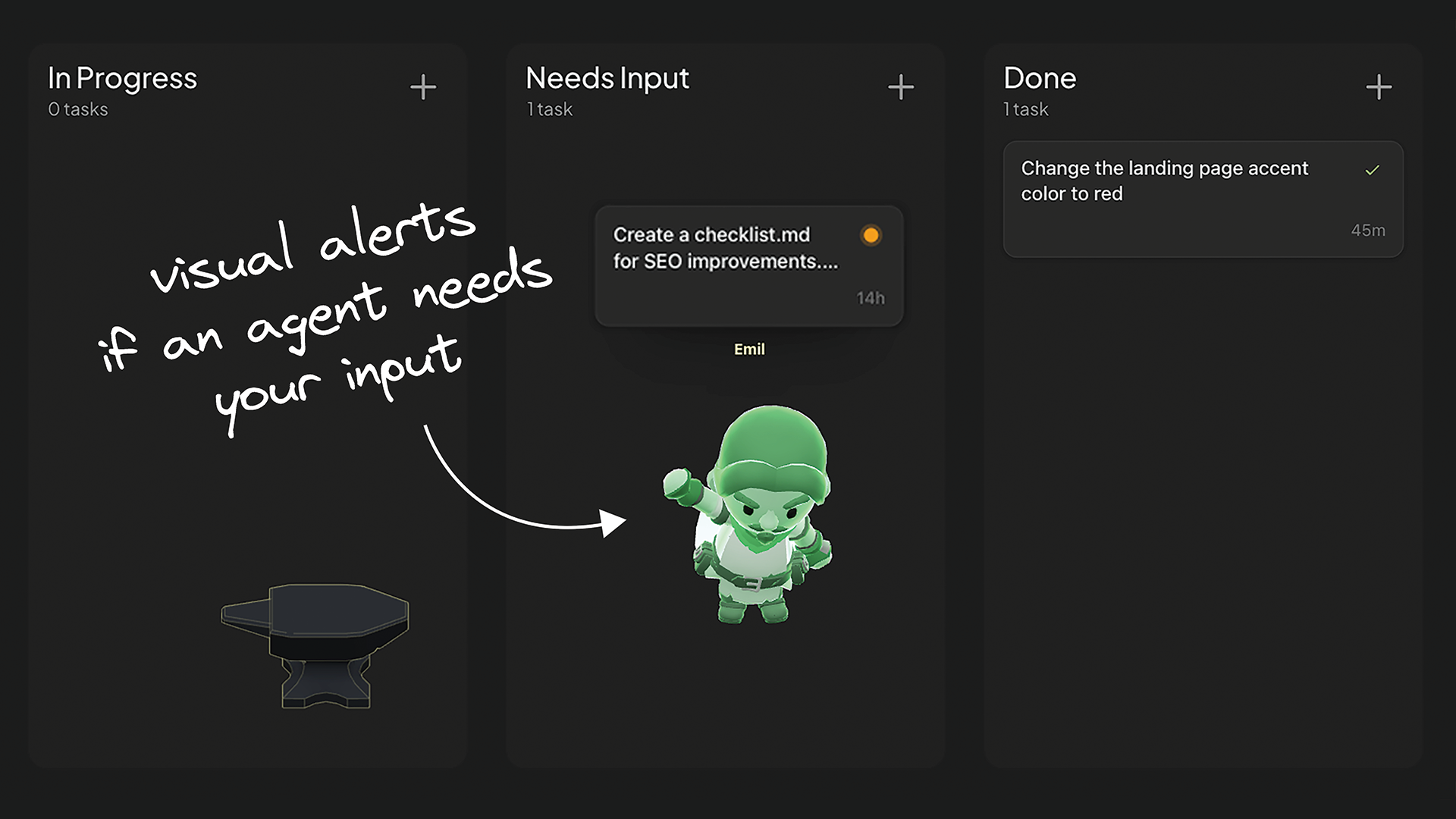
Know where your attention is needed. Orchestrate like a commander.
With a spatial interface, 100 agents isn't chaos — it's a map.
Zoom out to see the big picture. Zoom in to check on specifics. Direct your workforce with the same intuition you'd use in any 3D game.
Games already solved this
RTS games have been optimized for decades to give humans intuitive control over hundreds of units. We're just applying that to agents.
"millennial gamers are the best prepared generation for agentic work, they've been training for 25 years"


Billions in R&D, already done
The gaming industry spent decades and billions of dollars figuring out the best ergonomics for orchestrating swarms and managing large numbers of units.
Countless UX iterations. All focused on one question: how do you give a human intuitive control over many things at once? It would be stupid not to use that.
The vision
Imagine drag-selecting your best agents and sending them off to build an app. When they arrive, they already have everything they need.
Select Your Agents
Drag-select from your pool of specialized agents. Each one has unique capabilities and tools.
Send to Task
Point them to a project — a "building site" in your 3D world. They know where to go.
They Have Everything
Blueprint, context, and tools (MCPs) are all there. Your agents start building.
That's the future.
Beyond developers
Most people can't interact with terminals — and they shouldn't have to.
Your Digital Company
Agents as your workforce, you as the CEO. The agent-as-character metaphor bridges how companies operate today with the agent-powered future.
Instead of hiring a team, you orchestrate one.
The 1-Person Company
One human orchestrating hundreds of agents in the background. This is what enables it.
For Any Company Running Agents
HR, ops, support, engineering — any agent workflow, all controllable from a 3D world.
"Doesn't this look too childish?"
Yes — but that's exactly the point. Humans are wired for 3D environments and character-based interaction. It's what we evolved for. This is the most natural abstraction precisely because we're built for it.
Just because it doesn't look "hackery" doesn't mean it's less effective. Spreadsheets look professional — they're also terrible for managing real-time, parallel workflows.
A 3D interface with characters is approachable. A wall of terminal windows is intimidating and exclusionary. Accessibility matters.
The question isn't "does it look serious enough?" — it's "does it work better?"
And it does.
Ready to command your agents?
Be the first to experience the future of agent orchestration.